Some links here are affiliate links marked (paid link); I may earn a small commission at no cost to you. As an Amazon Associate I earn from qualifying purchases. Details
This is the companion to the Home Emergency Kit. Start there: water, food, medicines, flashlights, a radio and a power bank cover most Virginia outages. This guide is for longer outages, and for anyone weighing a power station, a generator or emergency heat. Each option has an upfront cost, ongoing fuel or charging, limits, and safety rules. Carbon monoxide from generators and fuel-burning heaters, and fires from heaters and candles, are the biggest outage risks according to the CDC, CPSC and NFPA.
Comparing your options
| Option | Upfront | Ongoing | Main limits |
|---|---|---|---|
| LED lights + batteries | Low | Batteries | Light only |
| Power station | ~$550 (1,000 Wh) | Recharging; solar optional | Small loads; hours, not days |
| Inverter generator | ~$1,000 | Gas or propane, oil, upkeep | Outdoors only; CO, shock, fuel storage |
| Indoor-rated propane heater | ~$145 | Propane | One room; CO, fire, oxygen; never while sleeping |
Prices from Amazon listings on November 3, 2026.
Light without power · Battery power stations (and solar) · Portable generators (outdoors only) · Cooking (outdoors only) · Staying warm · Specialized option, last resort: indoor-rated propane heaters
Light without power
Battery LED light is the default. The Red Cross says use flashlights, not candles.
- 1. Solar lantern. Light that recharges on a sunny windowsill.
How to use it: Charge it fully before storing; recheck each season. Sources: Red Cross: Power Outages.
Product option: LuminAID Nova inflatable solar lantern (75 lumens) (paid link) - 2. Chemical light sticks. Cheap, flame-free night lights for hallways and kids' rooms.
How to use it: Single use; check the date on the pack. Sources: Red Cross: Power Outages.
Product option: Cyalume 6-inch 12-hour light sticks, 10-pack (paid link) - 3. Rechargeable batteries and charger. Fewer disposables; recharge from a power station or car.
How to use it: Rechargeables lose charge in storage, so top them up every few months and keep alkalines as a backup. Sources: Ready.gov: Build a Kit.
Product option: Panasonic eneloop charger with 8 AA rechargeables (paid link)
About candles and oil lamps: I don't recommend them. NFPA says candles start thousands of home fires a year; battery light does the job without the risk. If you light one anyway, use a sturdy holder, keep it 12 inches from anything that burns, never leave it unattended or near home oxygen, and blow it out before sleep. Sources: NFPA: Candle Safety, Red Cross: Power Outages.
Battery power stations (and solar)
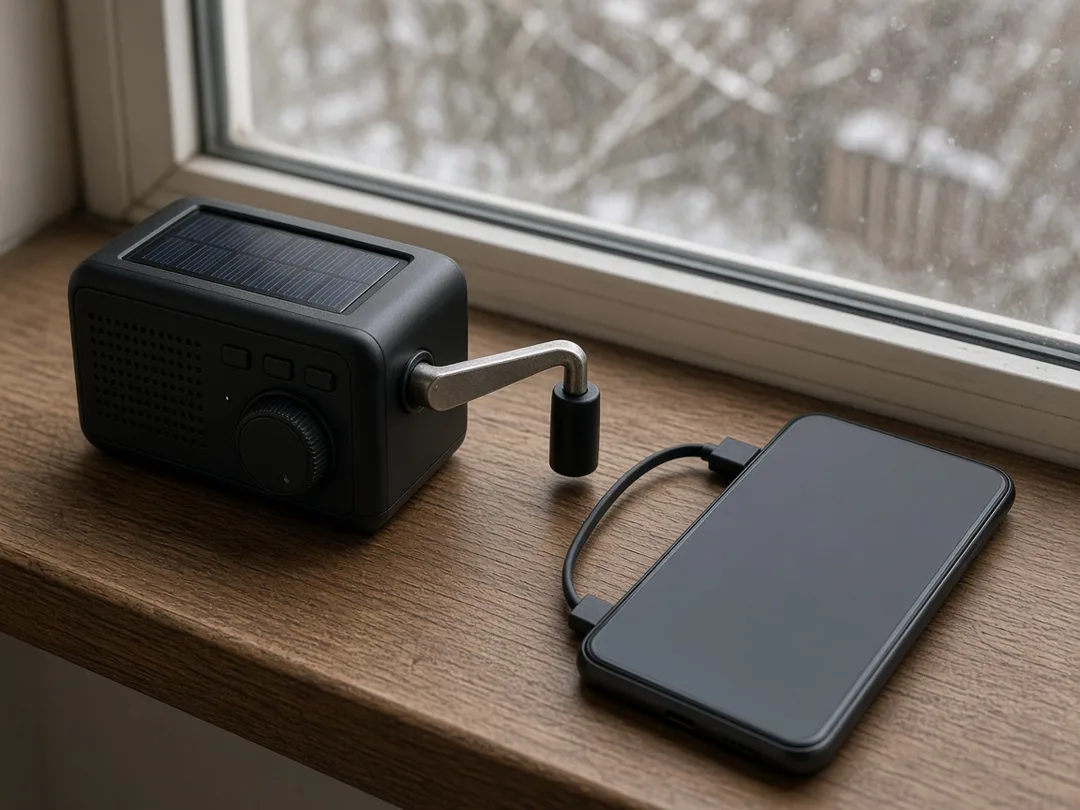
Quiet, no fumes, safe to run indoors. Good for phones, lights, a fan or a modem.
- 1. Battery power station. Indoor-safe backup power for small loads.
How to use it: Do the math for your own devices. Find each device's watts on its label. Runtime is roughly the battery's watt-hours divided by the device's watts, minus losses: converting to AC power uses some energy, so expect less than the label math. A 1,000 Wh station running a 50 W load lasts somewhere under 20 hours; a fridge or anything with a motor draws much more when it starts. Don't treat any power station as a medical backup until you've checked your device's actual draw with your provider or the device maker. Charge it every few months. Sources: Ready.gov: Power Outages, Jackery: Explorer 1000 v2 basic info.
Product option: Jackery Explorer 1000 v2 power station (1,070 Wh) (paid link) - 2. Solar panel (optional). Recharges the station on sunny days.
How to use it: Jackery lists the standard SolarSaga 100 (about 15 hours to fill the 1000 v2) and SolarSaga 200 (about 7.5 hours) for this unit and says not to mix panel wattages. We couldn't verify an in-stock U.S. Amazon listing for the standard panels on 11/3, so check compatibility on Jackery's page before buying any panel. Sources: Jackery: Explorer 1000 v2 basic info.
Portable generators (outdoors only)
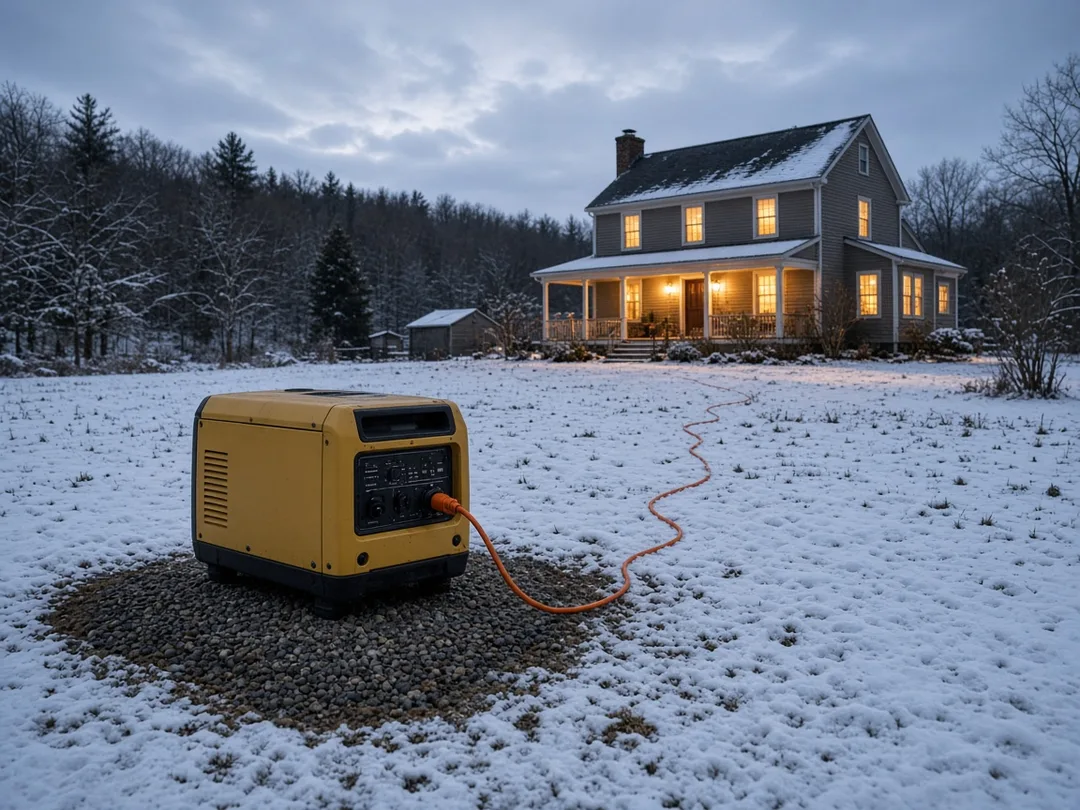
Generators run bigger loads like a fridge or sump pump, but they are the leading cause of outage carbon monoxide deaths. Every rule here comes from the CPSC, CDC and Red Cross.
- 1. Portable inverter generator. Runs a fridge, sump pump or well pump in a long outage.
How to use it:- Placement: outside only, at least 20 feet from the house, exhaust pointed away from windows, doors and vents. Never in a garage, basement, shed, carport or on a porch, even with doors open.
- Wet weather: generators can shock or electrocute. Run it on a dry surface under an open canopy where water can't pool, and dry your hands before touching it.
- Electrical connections: plug appliances in directly or with heavy-duty outdoor cords rated above the total load. Never plug a generator into a wall outlet (backfeeding); have a licensed electrician install a transfer switch.
- Starting vs. running watts: add up running watts, then allow for starting surge; the Red Cross notes some appliances draw up to 3 times their running power when they start.
- CO protection: a CO shut-off feature (this Champion has CO Shield) helps but does not replace battery CO alarms inside. If an alarm sounds, get everyone outside and call 911.
Product option: Champion 4,500 W dual-fuel inverter generator with CO Shield (paid link) - 2. Fuel can and stabilizer. Safe storage for generator fuel.
How to use it: Store fuel in an approved container outside the living space and away from any flame. Turn the generator off and let it cool before refueling. Gas goes stale in a few months without stabilizer. Sources: Red Cross: Generator Safety, CPSC: Portable Generator Safety Alert.
Product option: No-Spill 1405 2.5-gallon gas can (paid link) - 3. Fuel stabilizer. Keeps stored gasoline usable longer.
How to use it: Follow the label dose. Sources: Red Cross: Generator Safety.
Product option: STA-BIL Storage fuel stabilizer, 8 oz (paid link)
Cooking (outdoors only)
Never use a camp stove, grill or generator indoors or in a garage (CDC).
- 1. Camp stove. Hot food and coffee in a long outage.
How to use it: Outside only, on a stable surface. A 16 oz propane cylinder runs this stove about 1 hour on high, per the listing. Sources: CDC: Carbon Monoxide, CPSC: Carbon Monoxide Q&A.
Product option: Coleman Triton+ 2-burner propane camp stove (paid link) - 2. Propane cylinders. Fuel for the stove.
How to use it: Store outdoors or in a ventilated shed, away from the house. Sources: CPSC: Carbon Monoxide Q&A.
Product option: Coleman 16 oz propane cylinders, 2-pack (paid link) - 3. Stormproof matches. Lights the stove when igniters fail.
How to use it: Keep them in the stove kit, away from kids. Sources: CPSC: Carbon Monoxide Q&A.
Product option: UCO Stormproof match kit (paid link)
Staying warm
Start with the safest options: layers, sleeping bags, hats, and one shared room with doors closed and drafts blocked. If your home gets dangerously cold, the safest move is to go somewhere warm: a friend's or relative's home, or a warming center your county opens (Ready.gov, Red Cross).
Sources: Ready.gov: Winter Weather, Red Cross: Power Outages.
Specialized option, last resort: indoor-rated propane heaters
This is not a recommendation for every home. Only consider one after the options above, and only if local rules allow it and you will follow the manufacturer's ventilation requirements exactly.
- 1. Indoor-rated propane heater. Emergency heat for one room when the furnace is out and leaving isn't possible.
How to use it: An "indoor-safe" label does not make a fuel-burning heater safe for every room or household. It still burns fuel, uses oxygen and gives off carbon monoxide. CPSC: only use a propane heater specifically designed for indoor use; never run any unvented fuel-burning appliance in a room where people are sleeping; keep it 3 feet from anything that can burn, on a level, hard surface; turn it off when you leave the room or go to sleep; never refuel it while it's running. Follow the manual's ventilation rules exactly, keep kids and pets away, and keep a working smoke alarm and CO alarm nearby. A CO alarm is a warning, not a substitute for using the heater correctly (CPSC). Check local rules; some places restrict these heaters indoors. Never use a grill, oven, gas range or outdoor heater for heat. Sources: CPSC: Space Heater Safety, CPSC: Carbon Monoxide Q&A, CPSC: Keep Warm and Safe This Winter (2026), NFPA: Heating Safety, Ready.gov: Winter Weather.
Indoor-rated example, only if you meet every rule above: Mr. Heater Big Buddy 18,000 BTU indoor-rated propane heater (paid link)
General safety information, not medical or electrical advice. Read every manual. Checked against official sources on November 3, 2026.
Shop Lisa's prints
See the full shop →Nature photographs for your walls — my shop.